
Top 10 Open Source Text-to-Speech Tools (2026)
Choose the TTS workload first: preset voices, reference-audio cloning, multilingual synthesis, or a training toolkit. Then compare the code, model, and voice licenses and test the full text-to-audio path on your target hardware.
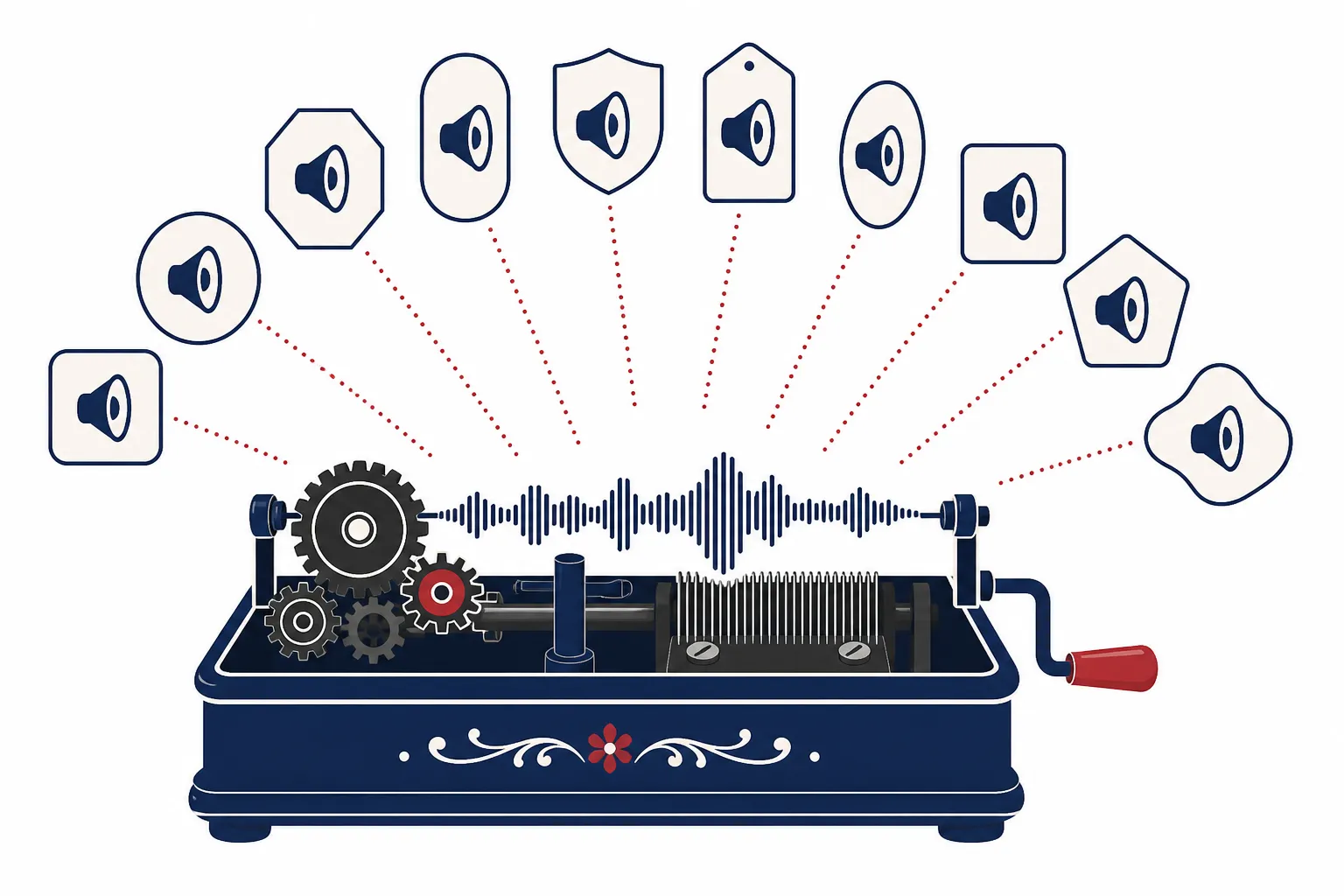
Selection method
Candidates are ordered by the clarity of their license terms, task fit, deployment shape, and the trade-offs exposed in their own documentation.
The 10 open source text-to-speech tools at a glance
| Candidate | Type | License | License note | Focus |
|---|---|---|---|---|
| #1 Kokoro-82M hexgrad / Community | Voice model | Apache-2.0 | Apache-2.0 model weights | 82M-parameter model with preset voices and documented CPU support |
| #2 Chatterbox Resemble AI | Voice cloning engine | MIT | Permissive MIT license (PerTh watermark) | Reference-audio voice cloning with built-in PerTh watermarking |
| #3 OpenVoice V2 MyShell AI | Voice cloning pipeline | MIT | Permissive MIT license | Instant voice cloning and granular tone/style control across 6 languages |
| #4 MeloTTS MyShell AI | Multilingual TTS engine | MIT | Permissive MIT license | Real-time oriented multilingual text-to-speech with English variants and international coverage |
| #5 Piper OHF-Voice / Community | Offline ONNX engine | GPL-3.0-or-later code (per-voice terms vary) | GPL-3.0-or-later (inspect voice cards) | Local ONNX text-to-speech engine with separate voice model terms |
| #6 Parler-TTS Hugging Face | Controllable TTS model | Apache-2.0 | Apache-2.0 code & checkpoints | Natural-language text prompt guidance for voice characteristics and acoustics |
| #7 StyleTTS2 yl4579 | Style diffusion TTS | MIT code (inspect model weights) | MIT code (inspect pretrained model terms) | High-expressiveness speech synthesis powered by style diffusion and adversarial training |
| #8 F5-TTS SWivid | Non-commercial reference model | MIT code / CC-BY-NC-4.0 official weights | Non-commercial official checkpoints | Non-autoregressive flow-matching zero-shot TTS model for English and Chinese |
| #9 ESPnet ESPnet Team | Toolkit & research framework | Apache-2.0 | Apache-2.0 license | End-to-end speech processing toolkit with extensible TTS recipes and neural vocoders |
| #10 eSpeak NG eSpeak NG Team | Formant speech synthesizer | GPL-3.0-or-later | GPL-3.0-or-later copyleft | Lightweight formant synthesis and G2P converter across 100+ languages |
Detailed candidate reviews
Short source-backed notes, ordered from rank #1 to #10.
Kokoro-82M
Developed by hexgrad / CommunityChatterbox
Developed by Resemble AIOpenVoice V2
Developed by MyShell AIMeloTTS
Developed by MyShell AIPiper
Developed by OHF-Voice / CommunityParler-TTS
Developed by Hugging FaceStyleTTS2
Developed by yl4579F5-TTS
Developed by SWividESPnet
Developed by ESPnet TeameSpeak NG
Developed by eSpeak NG TeamDecision guide
| Requirement | Recommendation | Why |
|---|---|---|
| Lightweight preset voice TTS with CPU support | Kokoro-82M (Apache-2.0) | Compact 82M model publishing Apache-2.0 model weights with preset voice packs and documented CPU support. |
| Zero-shot reference-audio voice cloning | Chatterbox (MIT) | MIT-licensed zero-shot voice cloning from reference audio clips with built-in PerTh watermarking. |
| Instant voice cloning with style control across 6 languages | OpenVoice V2 (MIT) | Provides instant voice cloning and style control across English, Spanish, French, Chinese, Japanese, and Korean. |
| Real-time CPU multilingual text-to-speech | MeloTTS (MIT) | Compact MIT-licensed TTS engine with native coverage for English variants, Spanish, French, Chinese, Japanese, and Korean. |
| Offline ONNX synthesis with per-voice licensing | Piper (GPL-3.0-or-later code (per-voice terms vary)) | Uses ONNX-based local synthesis; the maintained OHF-Voice repo is GPL-3.0-or-later and voice terms are published separately. |
| Text-prompt controllable voice traits | Parler-TTS (Apache-2.0) | Steers voice characteristics via natural-language text descriptions under full Apache-2.0 terms. |
| Expressive English speech via style diffusion | StyleTTS2 (MIT code (inspect model weights)) | Style-diffusion source with English-focused examples, PyTorch, and phonemizer dependencies. |
| Non-commercial zero-shot flow-matching research | F5-TTS (MIT code / CC-BY-NC-4.0 official weights) | Advanced non-autoregressive flow-matching model with MIT code, but official Emilia weights require CC-BY-NC-4.0 non-commercial compliance. |
| Customizable speech research & model training toolkit | ESPnet (Apache-2.0) | Apache-2.0 toolkit with documented recipes for custom TTS and related speech work. |
| Low-footprint G2P phonemization & 100+ language formant TTS | eSpeak NG (GPL-3.0-or-later) | Formant synthesis and text-to-phoneme output across more than 100 languages and accents. |
Questions people ask
What is the difference between voice cloning and preset voice text-to-speech?
Preset voice models like Kokoro-82M generate speech using pre-trained voice packs included with the model. Voice cloning engines like Chatterbox and OpenVoice V2 take a short reference audio clip from a target speaker and synthesize text in that speaker's voice.
Can open source text-to-speech run on CPU hardware without a GPU?
Yes. Kokoro-82M documents CPU support, Piper documents ONNX-based local synthesis, and MeloTTS documents CPU real-time inference. Profile the complete pipeline on your target hardware.
Why are some open source TTS model checkpoints restricted for commercial use?
While code repositories like F5-TTS may be MIT licensed, official pre-trained checkpoints such as Emilia-trained weights can carry CC-BY-NC-4.0 terms. Custom checkpoints still need a full audit of model, data, and dependency terms before commercial use.
How does Piper licensing work across code and voice models?
The active Piper engine (OHF-Voice/piper1-gpl) is GPL-3.0-or-later. Each selected voice has a model card whose terms must be checked separately before deployment.
Sources
- Kokoro GitHub repository
- Kokoro-82M Hugging Face model card
- Chatterbox GitHub repository
- Chatterbox Hugging Face model card
- OpenVoice GitHub repository
- OpenVoice research page
- MeloTTS GitHub repository
- Piper (OHF-Voice) GitHub repository
- Piper voices repository
- Parler-TTS GitHub repository
- Parler-TTS research paper
- Parler-TTS Mini v1 model card
- StyleTTS2 GitHub repository
- StyleTTS2 research paper
- F5-TTS GitHub repository
- F5-TTS research paper
- F5-TTS Hugging Face model card
- ESPnet GitHub repository
- ESPnet documentation
- eSpeak NG GitHub repository
- eSpeak NG documentation
Related internal pages
Related self-hosted guides and voice model comparisons:
 Official Weekly Digest
 Stay Updated on Open-Source AI
Get net-new open-source models, agent frameworks, inference engines, and tools delivered directly to your inbox every week.
This guide audited the Awesome Open Source AI registry and found that none of the ten selected candidates had an active standalone profile at the August 23, 2026 audit, so it links directly to official project repositories and model cards instead.
